
Explore docs & resources


Start your Chainlink journey
Learn & Explore
Build & Integrate
Operate & Scale
Explore Cross-Chain Interoperability with CCIP
Learn cross-chain concepts, workflows, and real-world use cases.
Build Cross-Chain Apps with CCIP Tutorials
Follow step-by-step guides with language switching (EVM, Rust, Move, etc.).
Monitor CCIP Transactions in Real Time
Track the progress and status of cross-chain transactions.
Understand How Data Feeds Power dApps
See how oracle data feeds deliver price feeds and reference data.
Integrate Data Feeds into Smart Contracts
Plug feeds into your apps with examples and addresses.
Stay Up to Date with Data Feeds
Rely on changelogs and schema updates for accuracy.
Learn How Data Streams Deliver Real-Time Data
Understand how low-latency streams support time-sensitive applications.
Implement Real-Time Use Cases with Data Streams
Use low-latency data in trading, gaming, and other live applications.
Deliver Reliable Low-Latency Data with Streams
Operate Data Streams at scale for critical, time-sensitive use cases.
Try it out
// SPDX-License-Identifier: MIT
pragma solidity ^0.8.20;

import {FunctionsClient} from "@chainlink/contracts/src/v0.8/functions/v1_0_0/FunctionsClient.sol";

import {FunctionsRequest} from "@chainlink/contracts/src/v0.8/functions/v1_0_0/libraries/FunctionsRequest.sol";
import {ConfirmedOwner} from "@chainlink/contracts/src/v0.8/shared/access/ConfirmedOwner.sol";

/**
 * THIS IS AN EXAMPLE CONTRACT THAT USES HARDCODED VALUES FOR CLARITY.
 * THIS IS AN EXAMPLE CONTRACT THAT USES UN-AUDITED CODE.
 * DO NOT USE THIS CODE IN PRODUCTION.
 */
contract FunctionsConsumerDecoder is FunctionsClient, ConfirmedOwner {
  using FunctionsRequest for FunctionsRequest.Request;

  bytes32 public s_lastRequestId;
  bytes public s_lastResponse;
  bytes public s_lastError;

  uint256 public s_answer;
  uint256 public s_updatedAt;
  uint8 public s_decimals;
  string public s_description;

  error UnexpectedRequestID(bytes32 requestId);

  event Response(bytes32 indexed requestId, bytes response, bytes err);

  event DecodedResponse(
    bytes32 indexed requestId, uint256 answer, uint256 updatedAt, uint8 decimals, string description
  );

  constructor(
    address router
  ) FunctionsClient(router) ConfirmedOwner(msg.sender) {}

  /**
   * @notice Send a simple request
   * @param source JavaScript source code
   * @param encryptedSecretsUrls Encrypted URLs where to fetch user secrets
   * @param donHostedSecretsSlotID Don hosted secrets slotId
   * @param donHostedSecretsVersion Don hosted secrets version
   * @param args List of arguments accessible from within the source code
   * @param bytesArgs Array of bytes arguments, represented as hex strings
   * @param subscriptionId Billing ID
   */
  function sendRequest(
    string memory source,
    bytes memory encryptedSecretsUrls,
    uint8 donHostedSecretsSlotID,
    uint64 donHostedSecretsVersion,
    string[] memory args,
    bytes[] memory bytesArgs,
    uint64 subscriptionId,
    uint32 gasLimit,
    bytes32 donID
  ) external onlyOwner returns (bytes32 requestId) {
    FunctionsRequest.Request memory req;
    req.initializeRequestForInlineJavaScript(source);
    if (encryptedSecretsUrls.length > 0) {
      req.addSecretsReference(encryptedSecretsUrls);
    } else if (donHostedSecretsVersion > 0) {
      req.addDONHostedSecrets(donHostedSecretsSlotID, donHostedSecretsVersion);
    }
    if (args.length > 0) req.setArgs(args);
    if (bytesArgs.length > 0) req.setBytesArgs(bytesArgs);
    s_lastRequestId = _sendRequest(req.encodeCBOR(), subscriptionId, gasLimit, donID);
    return s_lastRequestId;
  }

  /**
   * @notice Send a pre-encoded CBOR request
   * @param request CBOR-encoded request data
   * @param subscriptionId Billing ID
   * @param gasLimit The maximum amount of gas the request can consume
   * @param donID ID of the job to be invoked
   * @return requestId The ID of the sent request
   */
  function sendRequestCBOR(
    bytes memory request,
    uint64 subscriptionId,
    uint32 gasLimit,
    bytes32 donID
  ) external onlyOwner returns (bytes32 requestId) {
    s_lastRequestId = _sendRequest(request, subscriptionId, gasLimit, donID);
    return s_lastRequestId;
  }

  /**
   * @dev Internal function to process the outcome of a data request. It stores the latest response or error and updates
   * the contract state accordingly. This function is designed to handle only one of `response` or `err` at a time, not
   * both. It decodes the response if present and emits events to log both raw and decoded data.
   *
   * @param requestId The unique identifier of the request, originally returned by `sendRequest`. Used to match
   * responses with requests.
   * @param response The raw aggregated response data from the external source. This data is ABI-encoded and is expected
   * to contain specific information (e.g., answer, updatedAt) if no error occurred. The function attempts to decode
   * this data if `response` is not empty.
   * @param err The raw aggregated error information, indicating an issue either from the user's code or within the
   * execution of the user Chainlink Function.
   *
   * Emits a `DecodedResponse` event if the `response` is successfully decoded, providing detailed information about the
   * data received.
   * Emits a `Response` event for every call to log the raw response and error data.
   *
   * Requirements:
   * - The `requestId` must match the last stored request ID to ensure the response corresponds to the latest request
   * sent.
   * - Only one of `response` or `err` should contain data for a given call; the other should be empty.
   */
  function fulfillRequest(
    bytes32 requestId,
    bytes memory response,
    bytes memory err
  ) internal override {
    if (s_lastRequestId != requestId) {
      revert UnexpectedRequestID(requestId);
    }

    s_lastError = err;
    s_lastResponse = response;

    if (response.length > 0) {
      (uint256 answer, uint256 updatedAt, uint8 decimals, string memory description) =
        abi.decode(response, (uint256, uint256, uint8, string));

      s_answer = answer;
      s_updatedAt = updatedAt;
      s_decimals = decimals;
      s_description = description;

      emit DecodedResponse(requestId, answer, updatedAt, decimals, description);
    }

    emit Response(requestId, response, err);
  }
}
Demos
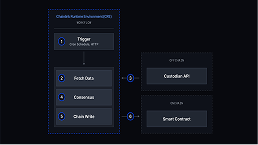
Custom Data Feed
See how you can bring your financial data onchain in a variety of different ways by creating a Net Asset Value feed, Proof of Reserve feed, or other custom data feed.
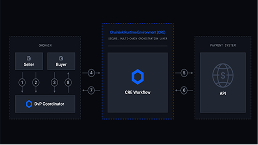
Delivery vs. Payment (DvP)
Learn how to sell a variety of assets via a Delivery vs. Payment transaction using the Chainlink Runtime Environment (CRE).
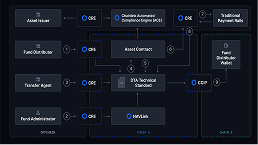
Digital Transfer Agent (DTA)
Learn how to invest in a variety of funds via a Digital Transfer Agent (DTA) transaction using the Chainlink Runtime Environment (CRE).

Explore Chainlink
Explore how the Chainlink standard powers tokenization and onchain finance through

Community Events


